Fire Protection for Warehouses & Industrial Buildings in the GTA
Warehouse fire protection in the GTA hinges on one thing: matching the sprinkler and detection design to what you store and how high you stack it. Toronto and the surrounding industrial belt, from Scarborough and North York out to Mississauga, Vaughan and the Markham corridor, are packed with distribution centres and plants where a small ignition can spread through racked goods in minutes. The right system is engineered for the hazard, not bought off a shelf.
Quick answer: A GTA warehouse needs a sprinkler system engineered to NFPA 13 for its exact storage height, commodity class and rack layout, usually a wet-pipe or ESFR (Early Suppression Fast Response) design, paired with a monitored fire alarm system under CAN/ULC-S536 and code-compliant extinguishers under NFPA 10. Because industrial hazards are high, the design must be reviewed whenever storage height, racking or contents change, and every system must be inspected and tested to keep it in operating condition under the Ontario Fire Code.
Why are warehouses higher-hazard buildings?
Warehouses concentrate fuel. Stacking product several metres high, often on combustible pallets and wrapped in plastic, creates vertical channels where a fire climbs fast and generates intense heat well above what an office or retail space ever sees. Large open floor areas, tall ceilings and wide-span construction also let smoke and flame travel before anyone reacts.
That combination is why industrial fire protection is treated as its own discipline. Under the Ontario Building Code and the Ontario Fire Code, storage occupancies are classified by their contents and configuration, and the required systems scale up accordingly. Cardboard, plastics, aerosols and flammable liquids each raise the hazard, and the sprinkler design has to keep pace.
- High ceilings and tall storage delay detection and increase fire growth.
- Combustible packaging and plastics burn hotter and faster than the goods alone.
- Large floor plates mean fire and smoke can spread far before suppression activates.
- Forklifts, battery charging and loading docks add ignition sources.
What are high-rack and ESFR sprinklers?
The heart of any warehouse system is the sprinkler design. For high-piled and rack storage, two broad strategies apply. The first uses ceiling sprinklers combined with in-rack sprinklers installed at intervals inside the storage racks, so water reaches deep-seated fires. The second uses ESFR heads, high-flow ceiling sprinklers engineered to detect early and deliver enough water to suppress the fire from the roof line alone, often removing the need for in-rack piping.
ESFR is popular in modern distribution centres because it simplifies racking and reconfiguration, but it only works within its listed limits for building height, water supply and commodity class. Where those limits are exceeded, an in-rack design or a stronger water supply may be required. Getting this right is an engineering decision, which is why our fire sprinkler installation work always starts with a hydraulic design review before any pipe goes up.
Whichever route fits your facility, the underlying system still needs a reliable water supply, and larger warehouses frequently rely on a fire pump to meet the required pressure and flow. Backflow protection on the connection to the municipal supply is generally tested annually under CSA B64.10.

How does storage arrangement change protection?
Two warehouses of identical size can require very different systems based purely on how goods are arranged. NFPA 13 ties the sprinkler design to storage height, rack depth, aisle width, the flue spaces between loads, and the commodity classification of what is stored. Change any of these and the fire hazard shifts.
This matters most when a tenant or operation changes. Raising your top-of-storage height, adding rows of racking, narrowing aisles or switching from Class I goods to plastics can quietly push an existing, compliant system out of specification. A sprinkler system sized for 4-metre storage will not necessarily protect the same building racked to 8 metres. Any material storage change in a Toronto, Etobicoke or Richmond Hill facility should trigger a fresh design check.
- Storage height drives the required sprinkler density and whether in-rack heads are needed.
- Commodity class (cartoned goods, exposed plastics, aerosols) sets the hazard baseline.
- Rack depth and flue spaces determine how water penetrates to the seat of a fire.
- Aisle width influences fire spread between rows.
What alarm, detection and monitoring does a warehouse need?
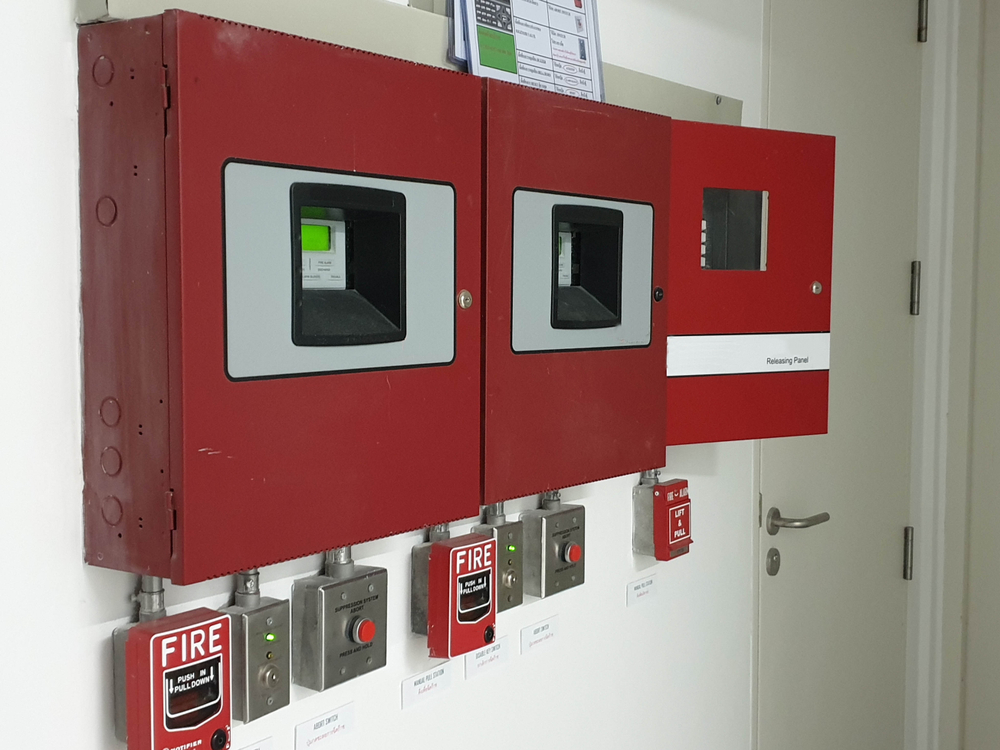
Suppression buys time, but detection and alerting decide how fast people evacuate and how quickly the fire service is dispatched. A warehouse fire alarm system is installed and verified to CAN/ULC-S537 at installation, then inspected and tested annually under CAN/ULC-S536. In large open volumes, standard smoke detection can be slow, so designs may use heat detection, beam detectors spanning wide aisles, or aspirating smoke detection for high-value or high-risk areas.
Critically, a warehouse alarm should be monitored. With 24/7 alarm monitoring, a signal reaches a listed station even when the building is empty overnight, which is exactly when an undetected fire does the most damage. We align fire alarm design, inspection and testing and monitoring to ULC and CFAA practice for facilities across the GTA. Where a building has occupied offices or mezzanines, voice evacuation may also be part of the mix.
Protecting a warehouse or plant?
Book a site assessment and we will review your storage, sprinkler design and detection against current code in one visit.
How is warehouse fire equipment inspected and maintained?
The Ontario Fire Code requires every fire protection system to be kept in operating condition, and it points to recognized standards for how often to inspect and test. For a warehouse, that means a coordinated schedule across water-based systems, alarms and portable equipment. Water-based systems follow NFPA 25, fire alarms follow CAN/ULC-S536, and extinguishers follow NFPA 10. Bundling these into a single program, the way our commercial fire inspection service does, keeps the paperwork straight and the building inspection-ready.
| System | Standard | Typical frequency |
|---|---|---|
| Sprinklers (wet / ESFR / in-rack) | NFPA 25 | Weekly to quarterly checks, annual and multi-year tests |
| Fire pump | NFPA 25 | Weekly/monthly running test, annual flow test |
| Standpipe & hose | NFPA 25 | Annual inspection and testing |
| Fire alarm | CAN/ULC-S536 | Annual inspection and testing |
| Portable extinguishers | NFPA 10 | Monthly quick check, annual maintenance |
| Backflow preventer | CSA B64.10 | Generally annual |
For a fuller breakdown of intervals across every device, see our guide on how often to inspect fire equipment in Ontario. Keeping records current also matters if the City of Toronto or a local fire prevention officer requests them.
How do I get a facility assessment?
The simplest starting point is a site assessment. We walk the building, review your storage arrangement and commodity types, check the existing sprinkler, standpipe, pump and alarm systems against current code, and flag anything that a change in operations may have outdated. From there you get a clear picture of what is compliant, what needs upgrading and what a maintenance program should cover.
Tovic Fire Protection Services serves Toronto and the GTA, from Scarborough and North York to Mississauga, Vaughan, Markham and beyond, aligning work to ULC, NFPA, CSA and TSSA standards and to City of Toronto permitting where required. Whether you run a single distribution centre or a portfolio of industrial buildings, one contractor can cover design, installation, inspection and 24/7 monitoring. Reach out through our contact page or explore the full range on our services overview.
Frequently asked questions
What sprinkler system does a warehouse need?
Most GTA warehouses need a wet-pipe sprinkler system designed to NFPA 13 for the specific storage height, commodity class and rack configuration. High-piled and rack storage often calls for an ESFR design or ceiling sprinklers combined with in-rack sprinklers. The correct choice depends on what you store and how high, so a design review is essential before installation.
What is ESFR?
ESFR stands for Early Suppression Fast Response. It is a class of high-flow ceiling sprinkler designed to detect a fire quickly and deliver enough water to actually suppress it rather than just control it. ESFR systems can often protect high-rack storage from the ceiling alone, avoiding in-rack sprinklers, when the building height, water supply and commodity class fall within the listed limits.
Does rack storage affect protection?
Yes, significantly. Storage height, rack depth, aisle width, flue spaces and the commodity class all change the fire hazard and therefore the sprinkler design. Adding racks, raising storage or switching to plastics or aerosols can make an existing system non-compliant, so any storage change should be reviewed against the current NFPA 13 design.
How often is it inspected?
Water-based systems such as sprinklers, standpipes and fire pumps are inspected and tested on the schedule in NFPA 25, with weekly to quarterly checks and annual and multi-year tests. Fire alarm systems are tested annually under CAN/ULC-S536, and portable extinguishers follow NFPA 10. The Ontario Fire Code requires these systems to be maintained in operating condition at all times.