How Many Fire Extinguishers Does My Building Need?
If you are asking how many fire extinguishers you need, the answer is driven by travel distance, floor area and the hazard class of what you store or do inside. For most Toronto and GTA buildings, the rule is simple: enough units so no one is ever more than the code distance away from one, on every floor. Below we translate the Ontario Fire Code and NFPA 10 into plain steps you can actually count.
Quick answer: Under the Ontario Fire Code and NFPA 10, place at least one Class A rated extinguisher so the maximum travel distance to reach it is 75 feet (about 23 m) from any point on a floor, then add units for higher-hazard areas. Class B flammable-liquid zones need coverage within 30 to 50 feet, and Class K kitchen units within about 30 feet of cooking appliances. Every storey is counted separately, so a typical small commercial floor needs a minimum of one to two extinguishers, and more as area or hazard increases.
The short answer: travel distance decides the count
You do not count extinguishers by headcount or by rooms. You count them by maximum travel distance, which is the actual walking path a person takes to reach the nearest unit, not a straight line through walls. For ordinary combustibles (Class A), NFPA 10 caps that distance at 75 feet (roughly 23 metres). Start in the far corner of each floor, and if the walk to the nearest extinguisher is longer than the allowed distance, you need another one.
Because the rule applies to the whole area, larger and more open floors need more units even when the hazard is low. A compact office suite in North York might satisfy the rule with a single well-placed extinguisher, while an open Etobicoke warehouse floor needs several. If you want the underlying schedule of what gets inspected and when, our guide on how often to inspect fire equipment in Ontario covers the calendar side of ownership.
Hazard classification: light, ordinary and high
Before you count, classify the space. NFPA 10 sorts occupancies into three hazard levels, and the level changes both how many extinguishers you need and how large each one must be:
- Light (low) hazard: offices, classrooms, places of worship and most retail sales floors, where the amount of combustible material is small.
- Ordinary (moderate) hazard: retail storage, light manufacturing, restaurants, parking garages and warehouses with moderate stock, common across Mississauga and Scarborough commercial units.
- High (extra) hazard: woodworking, auto repair, spray painting, warehouses with high-stacked flammable stock and similar operations where fires can grow fast.
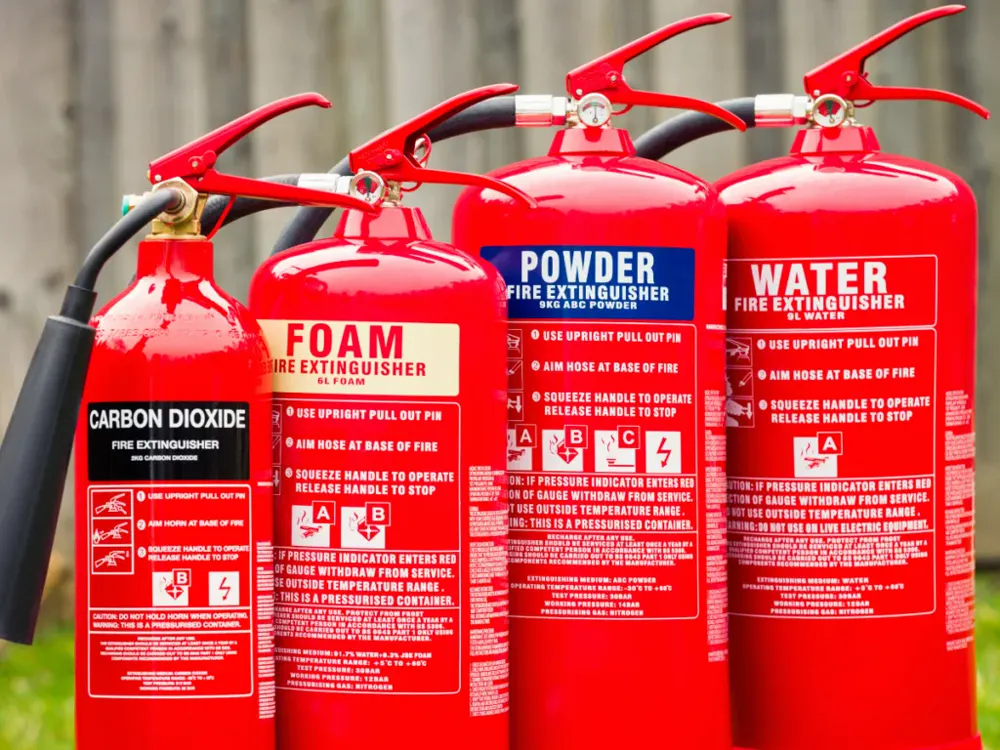
Higher hazard means larger minimum extinguisher ratings and, often, shorter travel distances, so the same square footage needs more equipment. If you are unsure which extinguisher chemistry matches your risk, our breakdown of fire extinguisher types explained maps ABC, CO2, water and Class K units to real-world hazards.
Maximum travel distance by class
Travel distance is the single most useful number for planning coverage. It differs by the class of fire you are protecting against, so a kitchen and a storeroom on the same floor may each drive their own unit. The table below summarizes the common maximums under NFPA 10.
| Fire / hazard class | Typical use | Max travel distance |
|---|---|---|
| Class A | Ordinary combustibles: paper, wood, textiles | 75 ft (≈23 m) |
| Class B (low hazard) | Small flammable-liquid use | 50 ft (≈15 m) |
| Class B (high hazard) | Larger flammable-liquid quantities | 30 ft (≈9 m) |
| Class C | Energized electrical equipment | Based on the underlying A or B hazard |
| Class K | Commercial cooking oils and fats | ≈30 ft (≈9 m) |
| Class D | Combustible metals | ≈75 ft (≈23 m), placed near the hazard |
Treat these as planning figures, not a substitute for a walk-through. The exact count also depends on the minimum extinguisher rating required for each hazard, which a qualified technician confirms on site. Our extinguisher inspection and service visits are a natural time to re-check that your coverage still matches how the space is used.
Placement, mounting height and signage
Counting the units is only half the job. They also have to be found and reached in seconds. NFPA 10 sets clear rules for how extinguishers are mounted and identified:
- Mounting height: the carrying handle sits no higher than 5 feet (1.5 m) for units up to 40 lb, and no higher than 3.5 feet (1.07 m) for heavier units. Keep the bottom at least 4 inches (100 mm) off the floor.
- Visibility: units must be conspicuous and unobstructed. Where a unit could be hidden by stock or partitions, add signage or arrows so it is visible from a distance.
- Along the path of egress: mounting near exits, stairwells and corridors puts extinguishers where people naturally move during an emergency.
Good placement pairs with the rest of your life-safety hardware. If your building relies on illuminated signs and battery units to guide people out, review our guide to emergency and exit lighting in Toronto so the two systems reinforce each other.
Special areas: kitchens, electrical and mechanical rooms
Certain spaces override the general count because their hazard is specific. A commercial kitchen with deep fryers or a wok line needs a Class K wet-chemical extinguisher within about 30 feet of the appliances, in addition to any Class A units serving the dining room. That portable unit backs up, but never replaces, a fixed commercial kitchen fire suppression system over the cooking line.
Electrical and mechanical rooms carry Class C risk from energized equipment, so many buildings place CO2 or clean-agent units there to protect gear without leaving residue. Server rooms across Toronto and Vaughan often get the same treatment. For a full picture of what an inspector looks for room by room, our Ontario Fire Code compliance checklist walks through the building systematically.
Not sure your coverage is compliant?
Our team can walk your building, count against the travel-distance rules and flag any gaps before your next inspection.
Get a placement assessment
The reliable way to answer how many fire extinguishers you need is to have someone measure travel distances against your actual layout and hazards. That matters most after a renovation, a change of use or new equipment, because moving a wall or adding a fryer can quietly put part of a floor out of reach. A short walk-through settles the count, the classes and the mounting points in one visit.
Tovic Fire serves Toronto and the GTA, from Markham and Richmond Hill to Mississauga and Etobicoke, and our work aligns to NFPA, ULC and CSA standards for City of Toronto permitted projects. Whether you need a handful of new units or a full building review, book a site assessment and we will confirm your coverage in writing. You can also see the wider scope of what we install and maintain on our services page.
Frequently asked questions
What is the maximum travel distance to an extinguisher?
Under NFPA 10, the maximum travel distance to a Class A extinguisher is generally 75 feet (about 23 metres) from anywhere in the space. For Class B flammable-liquid hazards the distance is shorter, typically 30 or 50 feet depending on the hazard level. Class K kitchen units are usually limited to about 30 feet from the cooking appliances.
How high should extinguishers be mounted?
NFPA 10 requires units to be mounted so the carrying handle is no more than 5 feet (1.5 m) above the floor for extinguishers weighing 40 lb or less, and no more than 3.5 feet (1.07 m) for heavier units. The bottom of the extinguisher should stay at least 4 inches (100 mm) off the floor. They must be visible, unobstructed and easy to reach.
Do I need one on every floor?
Yes. Travel-distance rules apply to each storey independently, so every floor needs its own extinguishers positioned so no one has to travel more than the allowed distance to reach one. Stairwells, exits and corridors are common mounting points. Larger or higher-hazard floors will need more units to satisfy the same distance rule.
Which extinguisher class for my business?
Most offices, retail and general commercial spaces use multipurpose ABC dry-chemical extinguishers, which cover ordinary combustibles, flammable liquids and energized electrical equipment. Commercial kitchens with cooking oils also require a Class K wet-chemical unit. Server rooms and sensitive electronics often add clean-agent or CO2 units. A site assessment confirms the right mix for your hazards.