Emergency & Exit Lighting Installation & Testing in Toronto
When the power fails and a building has to be cleared, emergency lighting is what keeps people moving toward the exits instead of standing still in the dark. For any commercial, retail, industrial or multi-residential property, reliable emergency lighting Toronto owners can prove is tested is not optional, it is law. This guide walks through what the systems are, where the code requires them, and the monthly and annual testing duties that keep your building inspection-ready across Toronto and the GTA.
Quick answer: Emergency and exit lighting must be installed along egress routes wherever the Ontario Building Code requires it, then maintained under the Ontario Fire Code with a monthly function test and an annual full-duration test, typically 30 minutes for most buildings. Emergency lights are battery-backed lamps that switch on when normal power fails; exit signs mark the way out and must stay illuminated on emergency power. Test results must be documented and kept on site for the fire inspector.
What counts as emergency and exit lighting
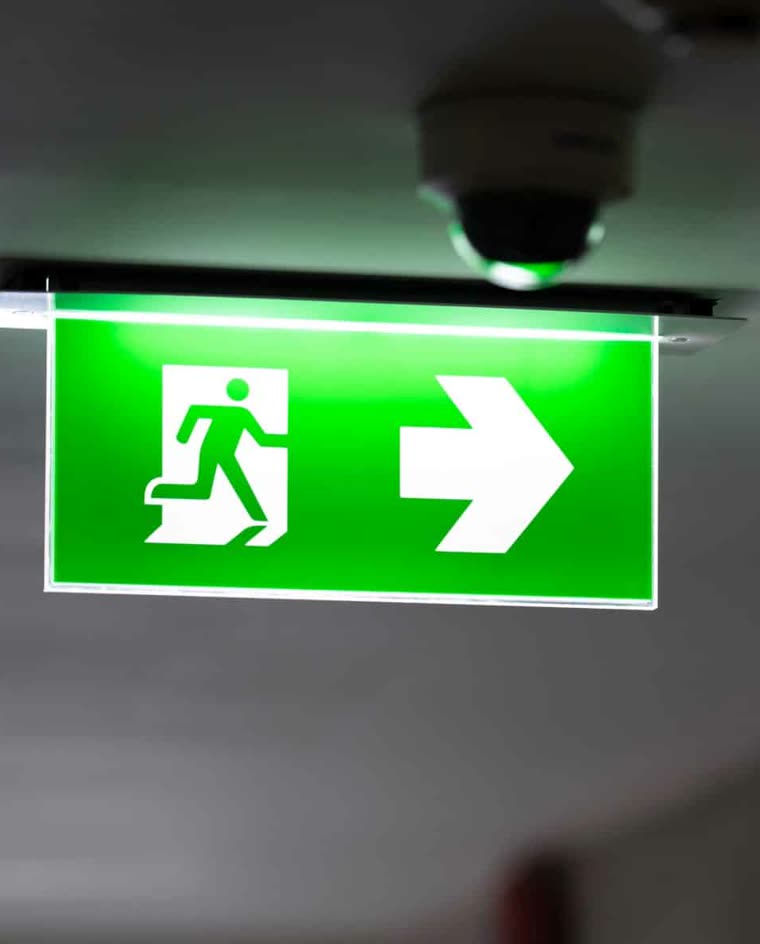
Two related systems often get lumped together, but they do different jobs. Emergency lighting refers to the battery-backed lamps, often the familiar twin-head "bug eye" fixtures, that switch on automatically when normal power is lost and illuminate corridors, stairwells and exit paths long enough for occupants to leave safely. Exit signs are the illuminated running-man or "EXIT" markers that point the way to the nearest exit.
Both are part of your building's life-safety package, sitting alongside detection and suppression. If you are mapping out everything that needs attention, our Ontario Fire Code compliance checklist shows how emergency lighting fits with alarms, sprinklers and extinguishers. Most installations in the GTA fall into one of two categories: self-contained units with their own internal battery, or centrally supplied systems fed from a battery bank or generator through an inverter.
Where the code requires it
The Ontario Building Code generally requires emergency lighting along the paths people use to leave a building, including corridors, stairwells, principal routes through open floor areas, and exterior exit landings. Exit signs are typically required over exit doors and at points where the direction to an exit is not obvious. The exact extent depends on the building's occupancy, size and layout, so the only reliable way to confirm coverage is a walk-through.
This applies well beyond downtown Toronto. We see the same requirements in office plazas in North York, warehouses in Scarborough and Etobicoke, retail units in Mississauga, and condo and apartment buildings in Vaughan and Markham. Once a system is installed, the Ontario Fire Code takes over and requires ongoing inspection and testing to keep it functional. If your overall coverage feels uncertain, a single annual fire inspection can capture lighting alongside every other system in one report.
Monthly and annual testing duties
Emergency lighting is one of the few life-safety items the Ontario Fire Code expects building owners to keep on a regular test cycle, with records to prove it. There are two routine tests, and it helps to understand what each one actually checks.
- Monthly function test: simulate a power failure and confirm every emergency lamp illuminates and each pilot or charge light is working. This is a quick pass-or-fail check that catches dead bulbs and obvious faults.
- Annual full-duration test: run the units on battery for their full rated emergency duration, typically 30 minutes for most buildings, to confirm the batteries can carry the load the entire time without dropping below the required light level.
| Test | What it checks | Frequency |
|---|---|---|
| Monthly function test | Simulate a power failure and confirm each emergency lamp illuminates and every pilot or charge light is working (a pass/fail check for dead lamps and obvious faults). | Monthly |
| Annual full-duration test | Run the units on battery for their full rated emergency duration (typically 30 minutes for most buildings) to confirm the battery carries the load without dropping below the required light level. | Annually |
The annual test is the one that matters most, because a unit can pass a monthly check yet still fail after ten minutes on battery. Inspections records must be kept on site and made available to the fire inspector on request. For a building-wide view of which items fall on which cadence, see how often fire equipment needs inspection in Ontario.
Code note: Under the Ontario Fire Code, emergency lighting is generally function-tested monthly and tested for its full required duration annually, and the results must be documented. The required emergency duration for most buildings is typically 30 minutes, though some occupancies require longer.
Battery units, inverters and maintenance
Most self-contained emergency lights in the GTA run on sealed lead-acid batteries that typically last about three to five years. Heat, poor ventilation and constant cycling shorten that life, which is why a unit in a hot mechanical room often fails sooner than one in a cool corridor. The annual full-duration test is usually how a tired emergency light battery is caught before it lets you down in a real outage.
Larger or centrally fed buildings may use an inverter or a battery bank feeding multiple fixtures, which centralises maintenance but raises the stakes if that single source fails. Whatever the configuration, good practice is to log every test, replace batteries on a planned schedule rather than waiting for failures, and address corroded terminals, dim lamps and flickering heads promptly. This same discipline applies right across your equipment, much like the recharge and service routine for a fire extinguisher inspection and service.
Emergency lights failing their test?
If your monthly checks are turning up dead heads or your annual test is coming due, book a Toronto and GTA site assessment and we will get every fixture verified, documented and back to code.
Upgrading to LED exit signs
Older exit signs running incandescent lamps draw more power, run hot and burn through bulbs. Modern LED exit signs use a fraction of the energy, last far longer, and place less strain on the backup battery, which can mean a smaller, longer-lived battery carrying the sign through an outage. For buildings still running aging signage, an upgrade often pays for itself in reduced maintenance and lower energy use while improving reliability.
An exit sign installation in Toronto also gives you a clean opportunity to correct placement, replace faded or damaged faces, and bring directional arrows into line with the actual egress routes. When we handle an upgrade we verify each sign stays illuminated on emergency power, because a sign that goes dark in an outage defeats its entire purpose.
Booking installation or testing in the GTA
Tovic Fire designs, installs, inspects and maintains emergency and exit lighting for buildings across Toronto and the Greater Toronto Area, work that is aligned with ULC, NFPA and CSA standards and carried out as City of Toronto permitted work where required. Whether you need a fresh install, an LED upgrade, or simply your monthly and annual emergency lighting testing handled and documented, we keep the paperwork an inspector wants ready on site.
If you are coordinating several systems at once, it is often simplest to fold lighting into a broader visit. Tell us what your building has and we will scope the right service, then keep you on schedule so nothing lapses. You can request a site assessment or browse the full range of fire protection services we deliver across the region.
Frequently asked questions
How often must emergency lighting be tested?
Under the Ontario Fire Code, emergency lighting is generally function-tested monthly to confirm the unit illuminates on loss of power, and once a year it is tested for its full required duration, typically 30 minutes for most buildings. Results should be recorded and kept on site for the fire inspector.
What is the monthly and annual test?
The monthly test is a quick function check: you simulate a power failure and confirm the lamps come on and the pilot light is working. The annual test runs the unit on battery for its full rated duration to confirm the battery still carries the load for the whole emergency period without dimming below code.
How long do emergency light batteries last?
Sealed lead-acid batteries in self-contained emergency units typically last about three to five years, depending on temperature, charging quality and cycling. The annual full-duration test is the usual way a failing battery is caught, since a unit can pass a monthly function check yet still die before the required 30 minutes are up.
Are exit signs required to be illuminated?
In most buildings the Ontario Building Code requires exit signs over exit doors and along egress routes, and these signs generally must remain illuminated and stay lit on emergency power if normal power fails. The exact requirement depends on the building's occupancy and configuration, which a site assessment will confirm.