Exit Sign Requirements & Testing in Ontario
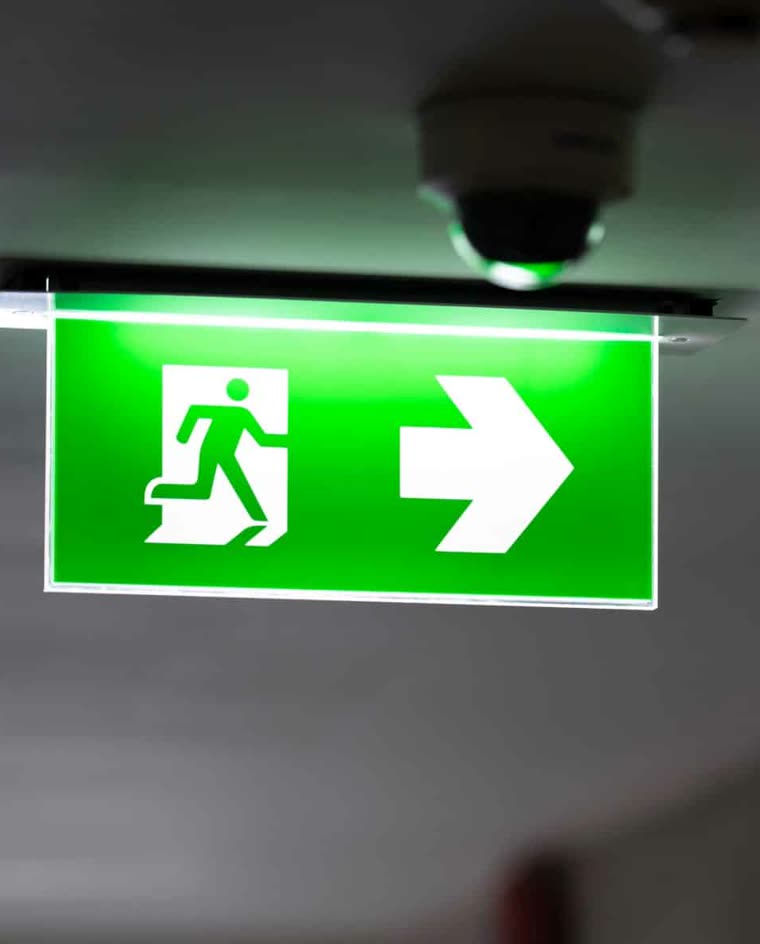
Exit sign requirements in Ontario come from the Ontario Building Code, which sets where signs go and how they are lit, and the Ontario Fire Code, which sets how they are tested and maintained. For most Toronto and GTA buildings that means an illuminated green running-man sign at every exit, kept visible on emergency power, and tested monthly and annually. Get any one of those three parts wrong and a fire inspector can write it up.
Quick answer: In Ontario, exit signs are required at every exit door and along the path of egress in most commercial and multi-unit buildings. They generally must be continuously illuminated running-man pictograms that stay lit on battery or generator backup if power fails. Under the Ontario Fire Code they are typically inspected monthly with a quick function check and tested annually under a full simulated power failure, often for a 30-minute duration.
Where are exit signs required?
The Ontario Building Code requires exit signage wherever occupants need to find their way out under stress, when the space is smoky, dark, or unfamiliar to visitors. In practice that means exit signs are needed in offices, retail, restaurants, assembly halls, care occupancies, industrial buildings, and the common areas of apartment and condo buildings across Toronto, Scarborough, North York, Etobicoke, Mississauga, Vaughan, Markham and Richmond Hill.
Signs are placed so that at least one is always visible from the required path of travel. Typical locations include:
- Above or beside every exit door and stairwell door that serves as a means of egress.
- At any point where the direction of travel changes or could be confused, using directional arrows.
- Along long corridors where the exit itself is not directly visible.
Exit signs work hand in hand with emergency lighting. If you are planning a fit-out or a code retrofit, our guides to emergency and exit lighting in Toronto and the Ontario Fire Code compliance checklist show how the pieces fit together.
The running-man pictogram standard
Newer installations in Ontario use the green running-man pictogram, the figure of a person moving toward a door, rather than the older red word EXIT. The pictogram follows the ISO 7010 and CSA graphics adopted into the Ontario Building Code, and it is recognised regardless of the language an occupant reads. Arrows are added to the sign to point toward the nearest safe exit when the door is not directly ahead.
Older buildings may still have legacy red EXIT signs, and those are often allowed to remain until they are replaced. When you renovate, add a suite, or change the exit layout, the new signs generally need to be running-man pictograms. This is a common trigger point during a fire code retrofit of an older Toronto building.
Illumination and battery backup
In most buildings the Ontario Building Code requires exit signs to be continuously illuminated, either internally lit or lit by an external source, and to remain visible if the normal power supply fails. That backup usually comes from a battery inside the sign, a central battery bank, or the building generator that also feeds the emergency lighting. Small self-luminous or photoluminescent signs are permitted only in limited, defined situations, so nearly all GTA businesses run electrically illuminated signs with backup power.

Because the sign and its backup are life-safety equipment, they need to be maintained on a schedule, not just installed and forgotten. Batteries lose capacity with age and heat, and a sign that looks fine on grid power can go dark within seconds of an outage if the battery is weak. That is exactly what the monthly and annual tests are designed to catch.
Monthly and annual testing
Under the Ontario Fire Code, illuminated exit signs and the emergency power that supports them must be inspected and tested on a set schedule, and the results recorded. The intervals below reflect common practice for exit signs and unit-equipment emergency lighting. Your fire safety plan or a fire protection contractor can confirm the exact requirements for your building.
| Task | Interval | What is checked |
|---|---|---|
| Visual check | Monthly | Sign is present, clean, illuminated and unobstructed; pilot or charge light is on. |
| Function test | Monthly | Briefly simulate power loss to confirm the sign stays lit on battery. |
| Full-duration test | Annually | Simulated power failure for the rated duration, commonly 30 minutes, confirming the sign stays legible to the end. |
| Battery and lamp service | As needed | Replace weak batteries and failed lamps; log the work. |
Keep the dated records on site. When the fire inspector visits, a clean log of monthly and annual tests is often the difference between a pass and an order to comply. The same discipline applies to the rest of your life-safety gear, which is why we recommend folding exit signs into your annual fire inspection so everything is checked and documented together.
Exit signs to install or test?
Our technicians install, inspect and test exit signs and emergency lighting to code across the GTA.
Common deficiencies
Most exit sign write-ups come down to a handful of recurring issues that are easy to fix once you know what an inspector looks for:
- Sign not illuminated. A burned-out lamp, tripped circuit, or dead driver leaves the sign dark on normal power.
- Battery will not hold. The sign lights on grid power but fails the annual full-duration test.
- Missing or wrong-direction arrows. Occupants are pointed the wrong way, or a required sign is absent at a turn.
- Obstructed or blocked signage. Shelving, banners, or stored goods hide the sign from the egress path.
- No test records. The equipment may be fine, but with no log the inspector cannot confirm it.
These faults tend to appear alongside emergency lighting problems, so it is worth reviewing both together. Building owners in Scarborough and North York often pair this with an emergency lighting installation when they upgrade older fixtures.
Get signs installed or tested
Whether you are opening a new space in Mississauga, retrofitting a condo corridor in Vaughan, or just need your annual testing done and documented, Tovic Fire installs, inspects and tests exit signs and emergency lighting to the Ontario Building Code and Ontario Fire Code. Our work aligns with ULC, NFPA and CSA standards, and we serve Toronto and the entire GTA. Reach out through our contact page or explore the full range on our services page to book a site assessment.
Frequently asked questions
Where are exit signs required?
Exit signs are generally required at every exit door and along the path of egress in most commercial, assembly, care and residential buildings, so an occupant can always see the way out. They are typically placed above or beside exit doors and at points where the direction of travel changes or could be confused, with directional arrows where the exit is not directly visible.
Do exit signs need to be lit?
In most buildings covered by the Ontario Building Code, exit signs must be continuously illuminated, either internally or externally lit, and must stay visible on emergency power if the normal supply fails. Small self-luminous or photoluminescent signs are permitted only in limited situations, so most Ontario businesses use electrically illuminated running-man signs with battery or generator backup.
How often are they tested?
Under the Ontario Fire Code, illuminated exit signs and their emergency power are generally checked monthly with a quick visual and function test, and tested annually under a full simulated power failure, commonly for the rated duration such as 30 minutes. Records of each test should be kept on site for the fire inspector.
What is the running-man sign?
The running-man sign is the green pictogram of a person moving toward a door, defined by the ISO 7010 and CSA standards adopted in the Ontario Building Code for newer installations. It replaced the older red EXIT word signs and is now the standard exit pictogram, often paired with directional arrows to point occupants toward the nearest safe exit.